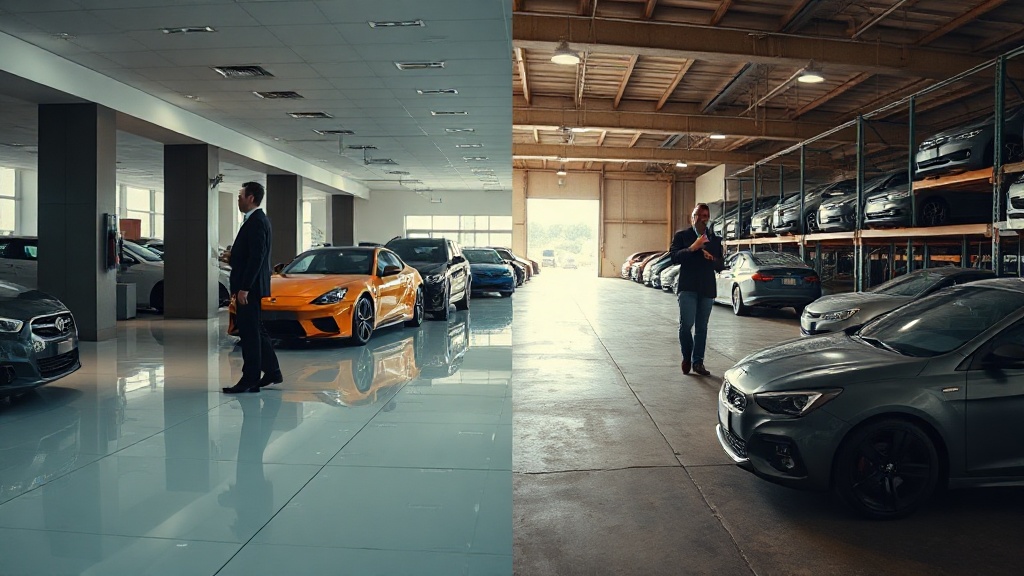
There is a woman who kept a wall in her study covered with hand-drawn maps. Not political maps with borders and capitals, but trade maps — lines that showed where goods moved between cities, where caravans stopped, where prices shifted and margins appeared. She had no particular interest in cartography. She was interested in the gaps. The places on the map where no one else was looking, and where value moved most freely.
She told me once that the most important skill she had ever developed was not the ability to read prices, but the ability to read territory. To understand which roads were overcrowded and which were empty, and why.
The car market in 2026 is a cartographer's map. The roads are there for anyone to see. The margins are in the reading.
What the Map Shows
The market for used vehicles in 2026 has a shape. It is not the same shape it had in 2021, when supply collapsed and any car with four wheels commanded a premium. It is not the shape of 2019, when normalcy held and experienced flippers moved high volumes on thin margins. The current shape is the result of a correction — inventory returning, consumer credit tightening, and electric vehicle hype cooling into uncertainty.
For the flipper who reads carefully, a correction is not a problem. A correction is where the margins live.
The map shows this clearly: used vehicle values are declining in some segments and holding in others. The categories where values are holding — or quietly rising — are exactly the ones that reward patient, informed buyers.
The Reliable Routes — High-Demand Categories
The most reliable category of flippable vehicle in 2026 is the Japanese-brand pickup truck or midsize SUV with clean history and under 100,000 miles. Toyota Tacomas, 4Runners, and Highlanders; Honda CR-Vs and Pilots; Subaru Outbacks and Foresters. These vehicles carry a premium in retail demand that consistently outpaces their wholesale cost, especially in markets where weather, terrain, or lifestyle creates genuine utility preference.
A Tacoma bought at wholesale for $22,000 with 75,000 miles can retail for $27,000 to $29,000 in a market where new vehicles are backordered and buyers need reliability. The reconditioning investment — tires, detail, minor mechanical — is predictable. The demand is reliable. The margin is not spectacular, but it is consistent.
Consistency is the cartographer's most reliable route.
The second category that performs in 2026 is the late-model domestic full-size pickup truck with towing or work packages. F-150s, Silverados, and Ram 1500s with higher trim levels have held value better than the market average, driven by commercial demand from small contractors, landscapers, and tradespeople who need capable vehicles and cannot access new inventory at current prices. A well-equipped 2021 F-150 XLT at wholesale represents a predictable flip with a defined buyer pool.
The Hidden Territories — Undervalued Segments
The most interesting territory on the map in 2026 is not the reliable route. It is the road that looks dangerous but is not.
Diesel-powered vehicles — particularly three-quarter ton and one-ton trucks from Ford, GM, and Ram — have seen wholesale prices decline faster than retail values would justify. The cause is not mechanical. It is sentiment: environmental regulation discussions, urban diesel restrictions in certain markets, and a generational shift in consumer perception have made diesel less fashionable. For buyers who understand the commercial market — ranchers, contractors, fleet operators — the demand for capable diesel work vehicles is unchanged. The spread between where these vehicles trade at wholesale and where they sell at retail has widened. That spread is where the flipper works.
A second undervalued segment is the older luxury vehicle from European brands with known service histories. A 2018 or 2019 Mercedes E-Class or BMW 5-Series that was professionally maintained by the original owner and traded in at a dealer represents a vehicle that wholesale buyers are often afraid to touch — because the segment has a reputation for expensive repairs — but that retail buyers want intensely. The fear is not always wrong, but it is frequently overstated. For a flipper with mechanical knowledge, access to a trusted independent European shop, and the patience to evaluate these vehicles properly, the margin available in this segment is significantly higher than in the commodity categories.
This is the hidden territory. It requires more work. But the map is less crowded.
Roads to Avoid
The cartographer who maps every road also marks the ones where travelers do not return.
In 2026, the most dangerous territory for flippers is the electric vehicle segment below the luxury threshold. This is not because EVs are bad vehicles — many are excellent. It is because the market for used EVs is unstable in ways that are difficult to predict. Battery degradation reporting is inconsistent. Charging infrastructure anxiety affects retail buyer confidence in unpredictable ways. Federal incentive changes have shifted new EV prices in ways that directly undercut used EV values. The flipper who buys a 2022 Nissan Leaf or Chevrolet Bolt at what appears to be a wholesale discount may find that the retail market has moved by the time the transaction closes.
Instability is not the cartographer's ally. Mark those roads and move around them.
The second category to approach with extreme caution is any vehicle with a reconstructed or salvage title. The margin appears attractive precisely because buyers are walking away. But the pool of retail buyers with access to financing for these vehicles is small, the time to sell is long, and the liability of what is undisclosed is real. For a flipper without specific expertise in this segment, the cost of being wrong is higher than the potential gain.
Reading the Season
The map is not static. The territory changes with the season.
In 2026, the spring and early summer buying season has driven strong retail demand in the pickup and utility segment — a pattern that holds across most years. Buyers in warmer months move faster, financed buyers have more options, and dealers are motivated to restock. This is the season when wholesale prices tighten and margins compress.
The season that rewards the patient flipper is late fall and winter. Wholesale prices soften as dealer reconditioning pipelines slow. Retail demand cools. But for the flipper who is willing to hold inventory into the following spring, the spread between a winter wholesale purchase and a spring retail sale is often the most reliable margin available anywhere on the map.
The woman with the maps on her wall understood this. She was not buying at the moment of greatest activity. She was buying when the roads were quiet and everyone else had stopped to rest.
The Margin Itself
The cartographer's trade, ultimately, is about precision.
A vehicle bought at $18,000 wholesale, reconditioned for $1,200 in tires and detailing, sold at $22,500 retail through a co-op with dealer license access represents a gross margin of $3,300. After transportation, listing fees, and transaction costs, the net is approximately $2,500 to $2,800. That is the economics of a reliable route.
A vehicle in the hidden territory — a diesel truck bought at $28,000 wholesale where the seller accepted a discount because of market anxiety, reconditioned for $800, and sold at $36,000 to a commercial buyer who needed capacity — represents a margin that does not appear on the reliable route. It appears on the roads that most buyers are avoiding.
The question the cartographer answers is not which vehicle is popular. It is which territory is underpriced relative to what a careful buyer can do with it.
The Cartographer's Lesson
The woman with the maps told me that the most profitable knowledge she had ever acquired was understanding where the fear was wrong. Not where fear was absent — fear is information, and most of it is accurate. But the places where the fear had outpaced the actual risk, where the map was marked as dangerous because it was unfamiliar rather than because it was genuinely treacherous.
In a correcting market, those places multiply. The map grows more interesting, not less.
The cartographer's trade is patient work. It requires the willingness to look at territory others have given up on, to ask whether the fear is correct, and to act with precision when the answer is no.
The map is there for anyone to read. The question is whether you have learned to read it.
Frequently Asked Questions
What types of cars make the most profit when flipping in 2026?
Japanese-brand trucks and SUVs — Toyota Tacoma, 4Runner, Honda CR-V, Subaru Outback — offer the most consistent margins at 10–15% of purchase price. Diesel full-size trucks and older European luxury sedans with service histories offer higher margins for buyers who can evaluate them accurately. Non-luxury EVs and salvage-title vehicles carry the highest risk for general-market flippers.
How much money do you need to start flipping cars for profit?
Most practical flippers start with $10,000–$20,000 in working capital — enough to buy a reliable mid-range vehicle at wholesale, cover reconditioning, and wait 30–60 days for the right retail buyer. Starting with less forces faster sales at lower prices. More capital opens access to higher-margin segments where fewer buyers compete.
What should you look for when buying a car to flip?
Focus on three things: a clean title, verifiable service history, and a spread between wholesale and retail values that can absorb reconditioning and transaction costs while returning a profit. Run every vehicle through a VIN history service and conduct a pre-purchase inspection before committing. The best flips are rarely surprises — they are vehicles where the numbers worked before the purchase.